ENTERPRISE PROJECT STRUCTURE
The Enterprise Project Structure (EPS) is an organizational framework that defines how projects are structured, managed, and interconnected within an enterprise.
In PLAN-R, the Enterprise Project Structure is a configurable hierarchical list that can contain an unlimited number of nodes in a single view of the EPS. The following node types are supported:
- Space;
- Project Group;
- Project;
- Schedule;
- Version.
Enterprise Project Structure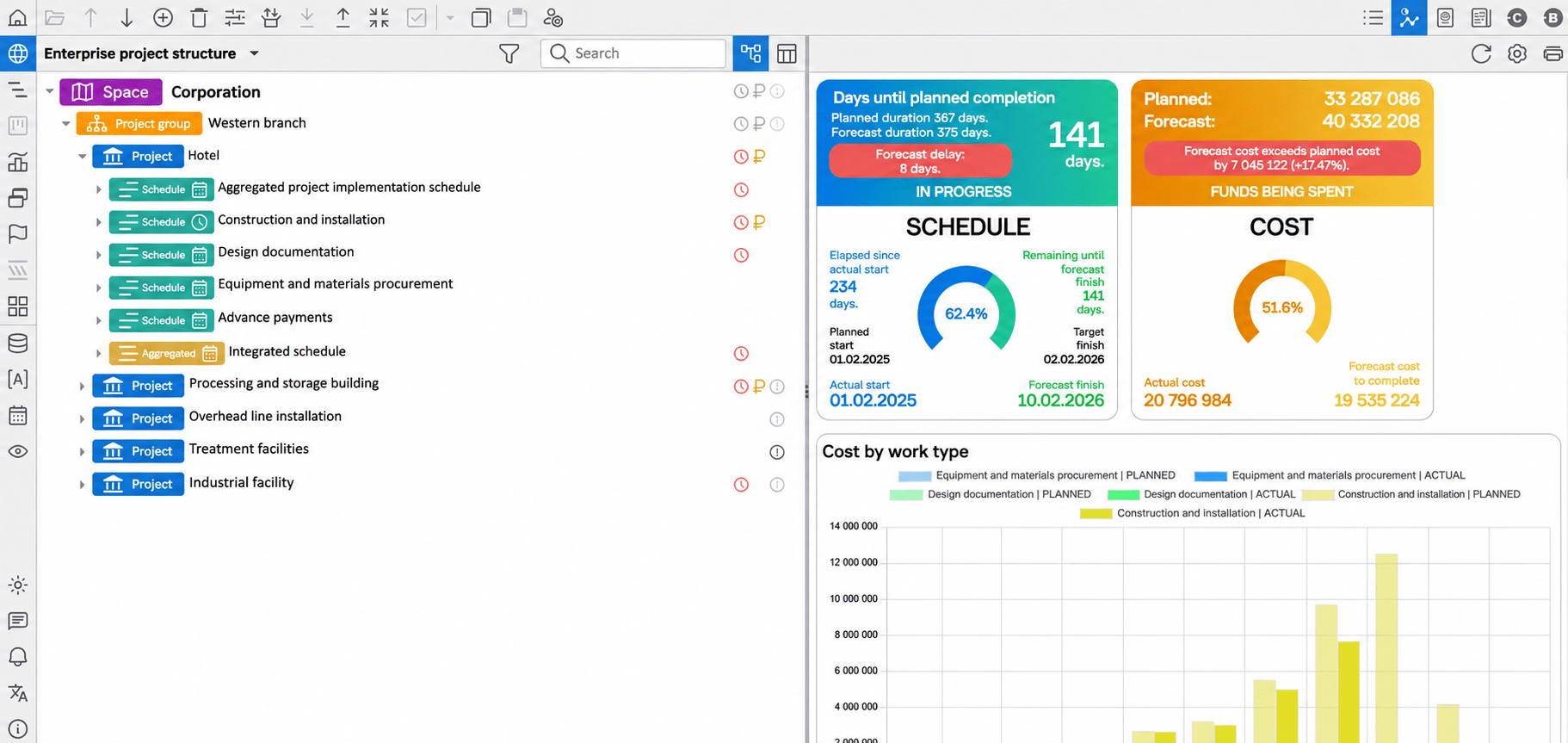
Space is a logical entity that consolidates information related to a company's project activities and includes the following structural elements: Project Group, Project, and Schedule.
Project Group is a collection of interrelated and interdependent projects that share resources, a budget, or objectives and can be carried out within a single organization or program. In network-based scheduling, resources, schedules, and budgets are managed for all projects within a project group. This helps optimize project execution by taking their relationships and dependencies into account and managing shared resources more efficiently. A project group therefore helps coordinate and manage multiple projects simultaneously, ensuring synchronization and efficient resource utilization.
Project is a set of interrelated tasks that must be completed to achieve a specific objective or accomplish a particular assignment within a defined time frame. In network-based scheduling, a project is modeled using a network schedule, enabling effective management of time, resources, and tasks to achieve project objectives within the required time frame.
Schedule is a planning tool used to visualize the project timeline. It is a dynamic model that shows the sequence of activities and provides information about resources and costs.
Version is a specific set of activities that make up a schedule. It contains a Work Breakdown Structure (WBS).
The following restrictions apply when creating the Enterprise Project Structure:
- The root node must be of the Space type and may have child nodes of the Project Group and Project types.
- A Project Group node may have child nodes only of the Project Group and Project types.
- A Project node may have child nodes only of the Schedule type.
- A Schedule node may contain Version elements and may not contain any other child nodes.
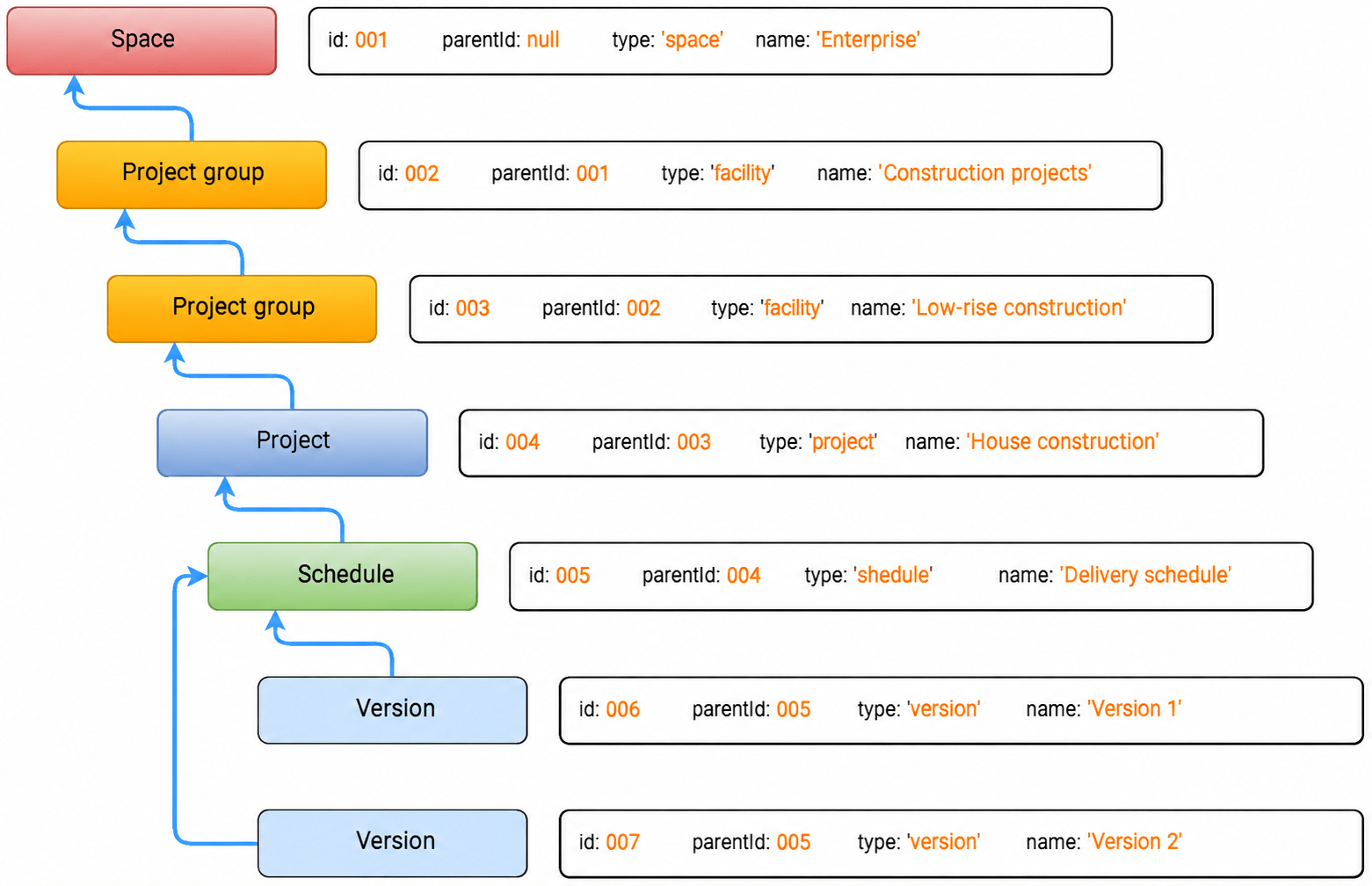
From an API perspective, the Enterprise Project Structure is therefore a tree data structure rooted in a space and composed of nodes of specific types. Each node contains the following fields:
EPS Fields
| Field | Field Type | Description |
|---|---|---|
| id | UUID V4 | Unique node identifier. |
| parentId | UUID V4 | Unique identifier of the parent node. Undefined for a space. Required for all other node types. |
| type | string | Node type. |
| name | string | Node name. |
EPS Node Types
| Value | Description |
|---|---|
| space | Space |
| facility | Project Group |
| project | Project |
| schedule | Schedule |
| version | Schedule Version |
Enterprise Project Structure Data Schema