ARCHITECTURE
PLAN-R is a client-server application that can be deployed on the customer's servers using container platforms such as Docker or Kubernetes.
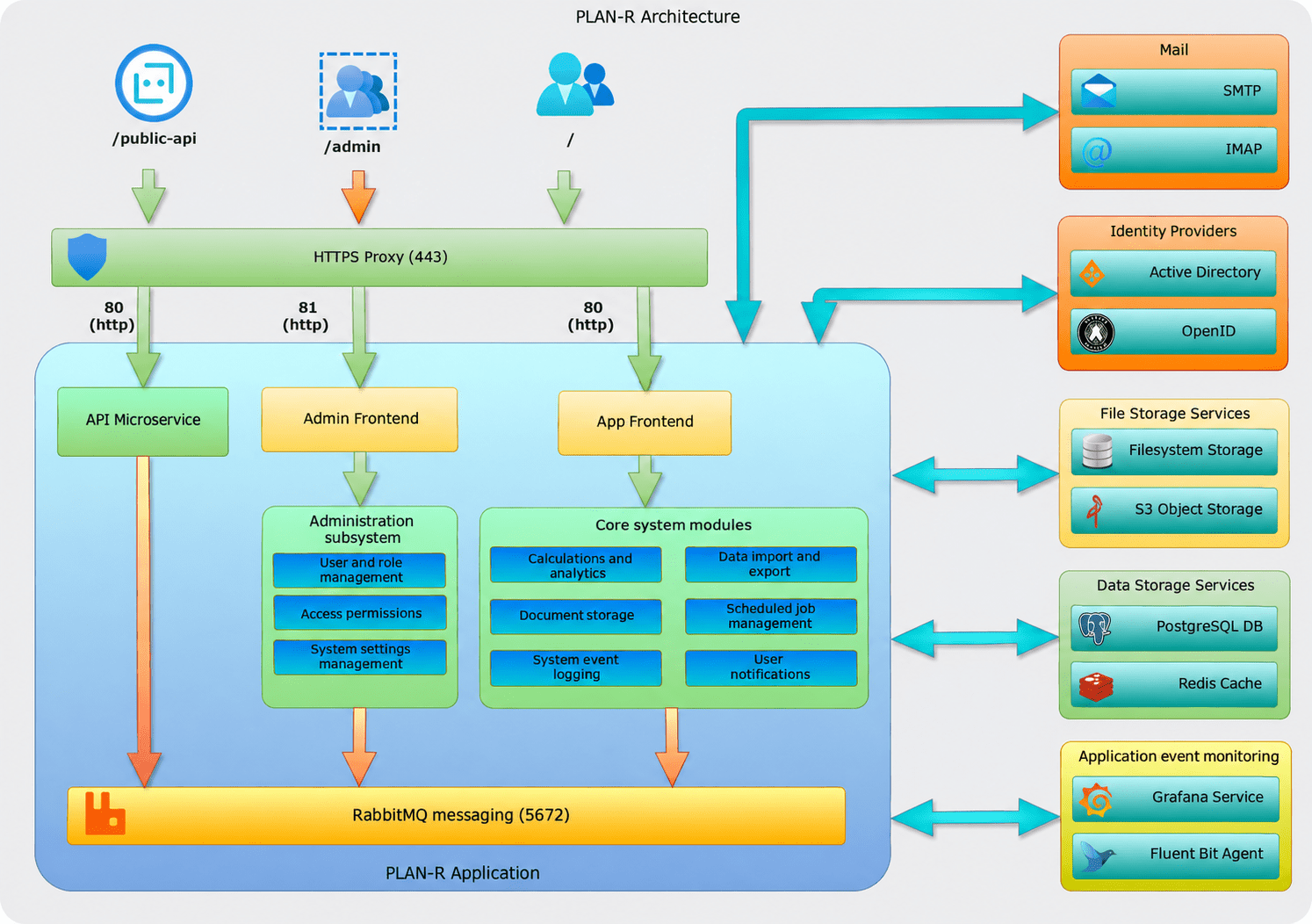
The client is a SPA (single-page application) that runs in widely used web browsers. The server uses a microservices architecture, with each service responsible for a specific area of the business model. Microservices exchange data through an event bus implemented using RabbitMQ. Data is stored in PostgreSQL or a compatible relational database. Files are stored in S3-compatible object storage. The system can send and receive email notifications through external SMTP and IMAP servers. Redis provides caching to improve data access speed. The Grafana, Loki, and Fluent Bit stack handles system log collection, viewing, and analysis.
The distribution package includes PostgreSQL, RabbitMQ, MinIO, Redis, Grafana, Loki, and Fluent Bit images by default.
Attention! For production deployments, running the infrastructure services in clustered configurations is recommended to ensure fault tolerance.
The client and server communicate over encrypted HTTPS connections. WebSocket is used for real-time messaging.
User authentication uses JWT tokens. When the system is deployed on the customer's servers, authentication through OpenID, SAML, Kerberos, and Active Directory is also available. Access to system objects is controlled by a permission-based role model.
The system can be managed and configured through environment variables and the web administration application.